
Survey for Nearshore
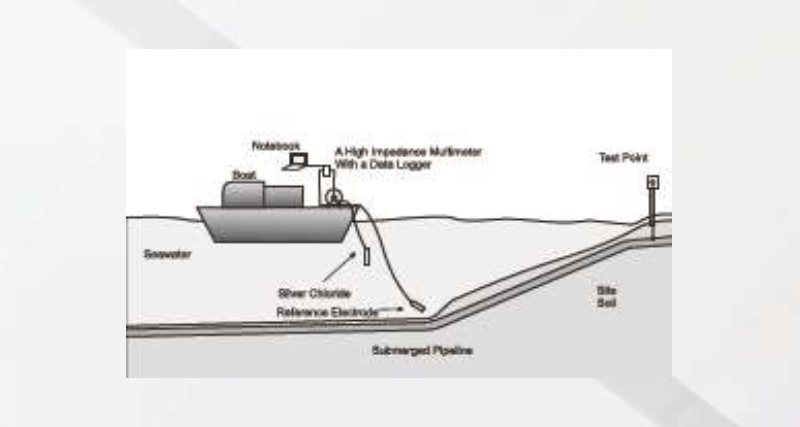
The inspection utilizing two reference electrodes has been widely accepted by the oil & gas industries all over the world to inspect their vast network of subsea pipelines. It has several advantages over other methods:
• Low Cost
• Does not involve expensive remote-controlled underwater vehicle
• Does not require divers
• No trailing wire that may cause problems to other vessels
During the survey, the boat position will be aligned with a pre-set DGPS coordinates of the subsea pipelines. Through this method, the subsea pipeline can be traced down to its entire length with higher accuracy. With the DGPS system in place, there is no requirement to use a marking buoy along the subsea pipeline route. As mentioned, divers are not required for this inspection method. To bring the reference electrode as close as possible to the pipeline, the reference electrode will be weighted using concrete.
The reference electrode, silver-silver chloride, will be housed in a heavy concrete casing weighing approximately 60 kg. This heavy concrete casing is meant to minimize drifting during the survey. It will also bring the reference electrode as close as possible to the pipeline. Prior to the start of the survey, an array of coordinate points spaced at a 200-meter interval from one chainage to another, will be plotted on the DGPS screen.
These pre-set coordinates will be used as guidance for the boat driver to navigate in a zigzag format to cross perpendicular to the pipelines. The data collected through this method will be more comprehensive and accurate. At every crossing point with the subsea pipeline, the weighted reference electrode (RE-2) will be released to the bottom of the sea, and at the same time, another set of reference electrodes (RE-1) will be lowered to the seawater, but its depth is only approximately 1 meter. At this point, the potential difference between the two electrodes will start to drift. Once the measurement is stable, the reading will be recorded using a data logger, if not manually. Subsequently, the weighted reference electrode will be lifted up approximately 2 meters using the boat winch.