
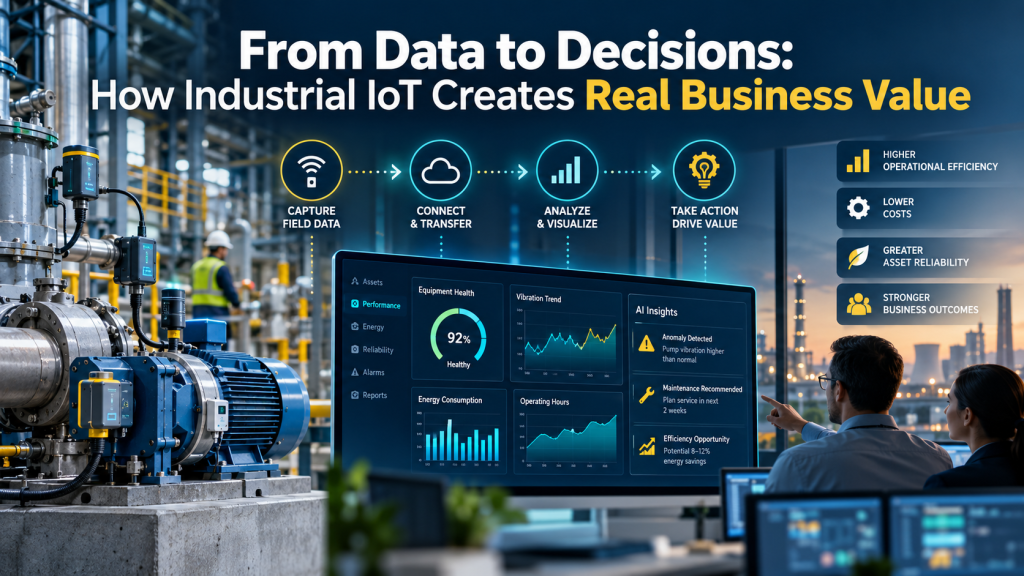
Industrial companies are generating more data than ever before.
Motors generate vibration and temperature data. Electrical systems provide voltage, current, power, demand, and energy information. Environmental sensors measure temperature, humidity, air quality, weather, and other conditions. PLCs, DCSs, SCADA systems, smart meters, gateways, and connected equipment continuously produce operational information.
But collecting data does not automatically create business value.
A factory can install hundreds of sensors and still experience unexpected equipment failures. An energy dashboard can display thousands of data points without identifying where energy is being wasted. A maintenance team can receive dozens of alarms without knowing which one deserves attention first.
The real value of Industrial Internet of Things (IIoT) begins only when data changes a decision.
The goal is therefore not simply to connect more equipment.
The goal is to build a closed loop:
Sense → Connect → Understand → Decide → Act → Verify
When this loop works, industrial data becomes more than a historical record. It becomes an operational asset that helps organizations reduce uncertainty, detect problems earlier, optimize resources, and make better engineering and business decisions.
The Difference Between Data and Business Value
Consider a vibration sensor installed on a critical pump.
The sensor might report:
4.8 mm/s RMS vibration
Technically, that is data.
But the number alone does not tell the maintenance team what to do.
Now add historical context:
Vibration has increased from 3.1 mm/s to 4.8 mm/s during the past three weeks.
That becomes information.
Add operational context:
The increase occurs predominantly during high-load operation.
Now the information becomes more meaningful.
Add analytics:
Vibration has increased 28% during the last three hours and remains significantly above the recent operating baseline.
Now we have an insight.
Finally, combine the insight with engineering knowledge:
Inspect coupling alignment, bearing condition, mounting integrity, and process loading before the next production campaign.
Now the data supports a decision.
If that decision prevents an unplanned shutdown, avoids secondary equipment damage, or allows maintenance to be performed during a planned window, the data has created business value.
This distinction is fundamental.
Industrial IoT should not be evaluated by how many sensors are installed, how sophisticated a dashboard looks, or how much data is stored.
It should be evaluated by the decisions it improves.
The Industrial Data-to-Decision Chain
A useful way to understand Industrial IoT is as a sequence of value-creation stages.
- Sense — Measure the physical world: vibration, temperature, pressure, electrical parameters, environmental conditions, operating state, flow, level, weather, or other relevant variables.
- Connect — Move the information reliably from field devices through gateways, industrial networks, APIs, cellular connections, Wi-Fi, or existing automation systems.
- Contextualize — Associate measurements with assets, operating modes, production conditions, locations, equipment criticality, and engineering limits.
- Analyze — Identify trends, anomalies, deviations, correlations, thresholds, baselines, and patterns.
- Decide — Determine whether intervention, inspection, maintenance, optimization, or further investigation is justified.
- Act — Execute the appropriate operational or engineering response.
- Verify — Measure whether the action produced the expected result.
The last step is often overlooked.
If an energy optimization project reduces compressor pressure, changes an operating schedule, or eliminates unnecessary loads, the monitoring system should verify the resulting energy reduction.
If maintenance corrects a machine problem, vibration should be compared before and after the intervention.
This creates an important feedback loop:
Measurement → Insight → Action → Measured Improvement
That is where Industrial IoT begins to support continuous improvement rather than simply monitoring.
Where Industrial IoT Creates Business Value
1. Earlier Detection of Equipment Degradation
One of the strongest IIoT use cases is monitoring critical equipment.
Many industrial failures do not appear suddenly. Equipment often passes through a degradation period before functional failure occurs.
During this period, measurable indicators may begin changing:
vibration increases, bearing temperature rises, motor current becomes abnormal, cycle time changes, differential pressure increases, energy consumption deviates from baseline, or the number of starts and stops becomes unusual.
Periodic manual inspection may miss these changes because measurements are taken only occasionally.
Continuous or higher-frequency monitoring gives the organization something extremely valuable:
time to respond.
The objective is not necessarily to predict the exact moment an asset will fail.
Often, simply detecting deterioration earlier is enough to create significant value.
Earlier detection can allow maintenance teams to investigate during normal working hours, prepare spare parts before intervention, coordinate production windows, prevent secondary damage, and avoid emergency maintenance.
Industrial IoT therefore changes maintenance from:
“Something failed. What happened?”
toward:
“Something is changing. What should we do?”
That change in timing can fundamentally change maintenance economics.
2. Better Maintenance Prioritization
Most maintenance organizations operate with limited resources.
There are always more inspections, work orders, preventive maintenance activities, and equipment concerns than available manpower.
Without good condition information, prioritization often depends heavily on fixed schedules, subjective judgement, or the loudest operational complaint.
IIoT introduces additional evidence.
Instead of asking only:
When was this machine last maintained?
teams can also ask:
What is the machine telling us now?
Condition trends, runtime, operating cycles, current, vibration, temperature, pressure, alarms, and process variables can help differentiate assets that are operating normally from assets that require attention.
This does not eliminate preventive maintenance.
It improves the information available when deciding where maintenance resources should be focused.
That principle is closely aligned with modern asset-management thinking. ISO 55000:2024 emphasizes realizing value from assets, while ISO 55013:2024 provides specific guidance for managing data in support of asset-management and organizational objectives.
The implication is important:
Industrial data should support asset-management objectives—not exist as a separate technology initiative.
3. Energy and Utility Optimization
Energy systems provide another powerful IIoT opportunity because inefficiency is often invisible.
Monthly electricity bills reveal total consumption, but they rarely explain exactly:
- where energy was consumed,
- when abnormal consumption occurred,
- which equipment contributed,
- whether consumption matched production,
- or whether operating changes actually improved performance.
More granular monitoring changes the discussion.
Electrical parameters such as energy, power, current, demand, power factor, loading, imbalance, and operating hours can be correlated with production schedules and equipment status.
This allows teams to identify situations such as:
A production line consumes significant electricity during non-production hours.
Two similar machines have significantly different energy consumption for the same operating duty.
Peak demand repeatedly occurs during simultaneous equipment startup.
An electrical load remains energized despite having no corresponding production activity.
Energy consumption increased after a maintenance or process change.
These observations transform energy management from a monthly financial review into an operational improvement process.
More importantly, savings can be verified.
The organization can establish a baseline, implement an improvement, and compare the resulting performance.
Without measurement, an efficiency initiative is an assumption.
With measurement, it becomes evidence.
4. Faster and Better Operational Decisions
Industrial operations contain thousands of signals.
The problem is increasingly not lack of data.
The problem is too much data without enough interpretation.
A dashboard containing hundreds of trends can still leave an operator or engineer asking:
What should I look at?
The next generation of industrial monitoring therefore needs an intelligence layer above visualization.
Instead of simply showing a temperature chart, the system might state:
Temperature has increased continuously during the last two hours and is now 12% above the seven-day operating baseline.
Instead of merely displaying electrical consumption:
Night-shift energy consumption is 17% above the previous seven-day baseline without a corresponding increase in production.
Instead of presenting environmental measurements:
Humidity has remained above the preferred operating band for 46 minutes. Check ventilation or cooling conditions.
The purpose of analytics is therefore not to replace engineers.
It is to reduce the amount of data engineers must manually interpret before recognizing something important.
Human expertise remains critical because operating context, equipment design, failure mechanisms, process conditions, safety implications, and business priorities still determine the correct action.
The best industrial intelligence systems combine:
machine-speed data processing with human engineering judgement.
5. Compliance and Traceability
Many industrial activities require evidence.
Environmental parameters may need to be documented. Critical temperatures may need historical records. Energy performance may need verification. Equipment operating conditions may need investigation following an incident.
Manual measurements can provide snapshots.
Connected monitoring provides history.
Timestamped records allow organizations to reconstruct what happened before, during, and after an abnormal condition.
This creates value even when everything is operating normally.
The data becomes an operational record that can support compliance activities, audits, engineering studies, incident investigations, root-cause analysis, performance verification, and management review.
In this context, data retention is not simply an IT requirement.
It can become part of operational risk management.
6. Better Engineering and Investment Decisions
Industrial IoT can also improve decisions beyond daily operations.
Consider a company evaluating whether to replace a motor, upgrade a cooling system, increase transformer capacity, install additional pumps, improve ventilation, or modify a production process.
Without sufficient operating data, engineering decisions may rely heavily on design assumptions or short-term observations.
Historical operating data creates a stronger evidence base.
Questions such as these become easier to answer:
How frequently does the equipment actually operate near maximum load?
What is the true daily and seasonal demand profile?
How often does temperature exceed the desired range?
Does equipment degradation correlate with particular operating conditions?
What happened to energy consumption after the process modification?
The resulting investment decision becomes more defensible because it is supported by actual operating behavior rather than assumptions alone.
Why Many IIoT Projects Fail to Create Value
The technology itself is rarely the only problem.
Many projects begin with the question:
What sensors and dashboard should we install?
A stronger starting question is:
What operational decision are we trying to improve?
This difference matters.
An organization could collect millions of measurements that nobody uses.
Conversely, a single temperature, vibration, current, or pressure measurement from one critical asset could generate substantial value if it prevents a major operating interruption.
Successful projects therefore begin with a business or operating problem, not a technology shopping list.
Typical starting problems might include:
Unplanned downtime: Can we detect degradation earlier?
Energy losses: Where is avoidable consumption occurring?
Maintenance uncertainty: Which assets actually deserve attention?
Critical asset visibility: What is happening when personnel are not nearby?
Environmental monitoring: Are conditions remaining within acceptable limits?
Operational optimization: Which operating conditions produce better performance?
Research and engineering: Can we collect enough historical data to understand the system?
Only after defining the decision should the organization determine what data is required.
Architecture Still Matters
Business value does not eliminate the need for good engineering architecture.
Industrial data may need to move from sensors and field instruments through PLCs, gateways, industrial networks, databases, cloud services, analytics platforms, dashboards, and enterprise applications.
ISA-95 provides a widely used framework for understanding information exchange between manufacturing-control and enterprise functions. Its purpose includes reducing the risk, cost, and errors associated with integrating these different layers of industrial systems.
A scalable architecture should also avoid turning every sensor deployment into an isolated application.
Once reliable data infrastructure exists, the same architecture can support multiple use cases:
machine condition, electrical monitoring, energy optimization, environmental monitoring, utilities, remote assets, production support, and engineering studies.
This is one reason modular IIoT architecture can become increasingly valuable over time.
The first use case builds the infrastructure.
Later use cases leverage it.
Data Quality Is More Important Than Data Quantity
Industrial analytics is only as reliable as the information feeding it.
A sophisticated algorithm cannot compensate for a badly installed sensor, incorrect scaling, poor calibration, missing timestamps, unreliable communication, or signals interpreted without operating context.
Industrial IoT therefore still requires traditional engineering disciplines:
instrument selection, sensor installation, calibration, signal validation, electrical design, communication reliability, asset identification, maintenance strategy, and knowledge of the physical process.
This is especially important when organizations begin implementing artificial intelligence and machine learning.
AI can detect patterns extremely quickly.
But if the underlying data does not represent the real physical system correctly, the result can simply be a faster wrong conclusion.
For this reason, the future of Industrial IoT is unlikely to be purely an IT domain.
It requires collaboration between operations, maintenance, reliability, electrical and instrumentation engineering, process engineering, data specialists, and business decision-makers.
Cybersecurity Must Be Built In
Connecting industrial equipment creates value, but connectivity also introduces risk.
Industrial IoT systems therefore need appropriate cybersecurity architecture from the beginning.
The ISA/IEC 62443 series defines requirements and processes for securing industrial automation and control systems and takes a lifecycle approach covering both operational technology and information technology environments.
NIST’s updated IR 8259 Rev. 1, published in April 2026, likewise emphasizes cybersecurity considerations throughout the IoT product lifecycle rather than treating security as an afterthought.
Practical implementation may include network segmentation, authentication, device identity, encrypted communication, access control, secure configuration, software lifecycle management, monitoring, backups, and clear ownership of connected assets.
The objective should be:
connect what creates value, while controlling the risk created by connectivity.
From Dashboard Projects to Value Projects
One of the most important changes in Industrial IoT thinking is moving away from measuring success by technical deployment.
Traditional project metrics might be:
50 sensors installed.
20 dashboards created.
10 million data points collected.
Those are implementation metrics.
They do not demonstrate value.
Better measures are:
Abnormal conditions detected earlier.
Emergency maintenance reduced.
Energy consumption reduced.
Inspection resources better prioritized.
Critical equipment visibility increased.
Engineering investigation time reduced.
Maintenance decisions supported by evidence.
Operating improvements verified using before-and-after data.
This is consistent with what leading digital manufacturers are demonstrating globally.
The World Economic Forum’s Global Lighthouse Network shows that organizations implementing digital technologies at scale—including advanced analytics and AI—have achieved significant improvements in productivity, quality, lead time, energy, and other operational measures. In its September 2025 cohort, the Forum reported average improvements including a 40% increase in labour productivity and a 48% reduction in lead time, with selected digital use cases also demonstrating major improvements in defects, energy consumption, and cycle time. These results should not be interpreted as the effect of IIoT alone, but they illustrate what becomes possible when digital technology is connected directly to operational improvement.
Technology generates the capability.
Operational change generates the value.
Start Small, Prove the Value, Then Scale
Companies do not need to connect an entire factory before Industrial IoT becomes useful.
In many cases, the strongest approach is to begin with one clearly defined problem.
For example:
one critical pump with recurring reliability problems,
one electrical distribution area with uncertain consumption,
one compressor system suspected of inefficient operation,
one warehouse requiring environmental monitoring,
one remote facility that currently depends on manual inspection,
or one production line where operating data could support process optimization.
Define the baseline.
Identify the decision that needs improvement.
Determine the minimum data required.
Collect reliable history.
Generate actionable insight.
Take action.
Then measure whether the result improved.
This creates a value hypothesis that can be tested:
Problem → Data → Insight → Action → Measured Outcome
If the use case works, expand it to additional assets, systems, lines, or sites.
This approach reduces implementation risk while creating evidence for future investment.
The Business Case Should Be Simple
Industrial IoT economics should ultimately connect to measurable value.
A conceptual model can be expressed as:
Annual Business Value = Avoided Downtime + Maintenance Savings + Energy Savings + Productivity Improvement + Quality Improvement + Risk Reduction − Total System Cost
Not every component needs to be monetized immediately.
Some applications primarily reduce risk or improve visibility.
But the organization should still define why the data matters.
For a critical machine, value might come from avoiding one major failure.
For electrical monitoring, value may come from identifying recurring energy losses.
For environmental monitoring, the value may be compliance evidence and faster response to abnormal conditions.
For remote assets, value may come from reducing manual inspection visits.
For engineering studies, value may come from obtaining enough reliable data to make a better capital investment decision.
Different use cases create value differently.
That is why Industrial IoT should not be sold or implemented as a one-size-fits-all dashboard.
Industrial Intelligence Is the Next Step
Industrial IoT began largely as a connectivity problem:
How do we get data from machines?
That problem is increasingly solvable.
The more important question is becoming:
How do we turn all this data into better decisions?
This changes the role of industrial platforms.
Monitoring tells us what is happening.
Analytics helps identify what is changing.
Engineering context helps explain why it matters.
Decision support helps determine what should happen next.
And measurement verifies whether the action worked.
This is the transition from Industrial IoT to Industrial Intelligence.
How Rekacipta Approaches the Problem
At Rekacipta, we believe industrial data is valuable only when it contributes to a better operating decision.
Our approach therefore combines sensing, connectivity, monitoring, analytics, and engineering context rather than treating dashboards as the final objective.
Through Siteplore, industrial data can be applied to use cases such as critical-machine monitoring, electrical and energy visibility, environmental sensing, distributed data collection, and custom operational monitoring. The intelligence layer then adds trends, baselines, anomaly logic, and engineering context to help teams identify what deserves attention.
But technology remains only one part of the solution.
Real improvement happens when operational data is connected with reliability knowledge, electrical and instrumentation engineering, maintenance strategy, process understanding, and the people responsible for acting on the information.
The goal is simple:
Know what is happening. Understand what it means. Decide what to do next.
That is how Industrial IoT moves from data collection to business value.
Start With the Problem, Not the Platform
If your organization is considering Industrial IoT, the first conversation does not need to be about sensors, cloud platforms, dashboards, or artificial intelligence.
Start with three questions:
What problem are we trying to solve?
What decision would become better if we had the right data?
What measurable outcome would prove that the solution worked?
Once those questions are clear, the technology becomes much easier to define.
And that is ultimately the most important principle of industrial digitalization:
Do not collect data simply because you can. Collect the data that helps someone make a better decision.
References and Further Reading
ISO 55000:2024 — Asset management — Vocabulary, overview and principles. The 2024 edition emphasizes decision-making, asset-management outcomes, and realizing value from assets.
ISO 55013:2024 — Asset management — Guidance on the management of data assets. Provides guidance for managing data in support of asset-management and organizational objectives.
ANSI/ISA-95 / IEC 62264 — Enterprise-Control System Integration. Framework for information exchange between industrial-control, manufacturing-operations, and enterprise functions.
ISA/IEC 62443 — Industrial Automation and Control Systems Security. Consensus-based cybersecurity standards addressing secure industrial automation and control systems.
NIST IR 8259 Rev. 1 — Foundational Cybersecurity Activities for IoT Product Manufacturers, 2026. Guidance addressing cybersecurity throughout the IoT product lifecycle.
World Economic Forum — Global Lighthouse Network. Case evidence from advanced manufacturing sites applying digital technologies, analytics, and AI to operational transformation.